Twenty-two furniture projects, from prototype to series
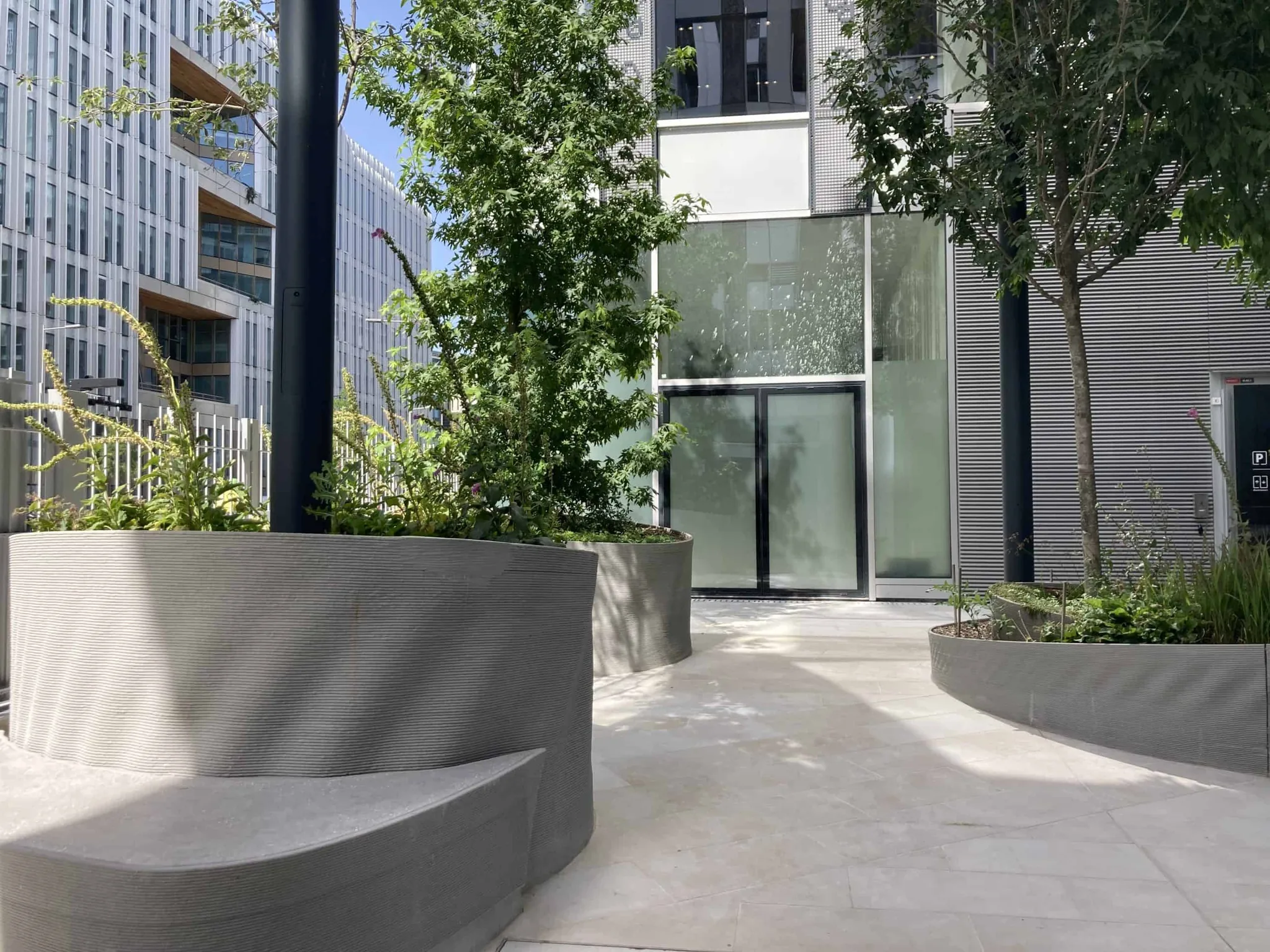
L'Archipel, VINCI headquarters: 95 unique planters and 11 benches, 11 300 L of printed concrete.
Furniture made with XtreeE technology ranges from a single exhibition vase to a hundred-piece campus deployment, for clients including VINCI Construction France, Roche Bobois, Icade, Serge Ferrari and a dozen French municipalities. Some pieces sit in corporate lobbies. Most sit outdoors, in public space, taking weather and use.
What makes furniture interesting commercially is the economics of variation. A mould pays for itself over hundreds of identical units. Printing pays for itself the moment every unit differs, which is exactly what designers and municipalities ask for.
Street furniture and public space
The largest deployment to date is L'Archipel at VINCI's headquarters in La Defense: 95 unique planters and 11 benches across a 76 000 m² campus, 11 300 litres of printed concrete, with every single planter geometrically distinct. That is the mass customisation argument made concrete, at a scale no formwork process could absorb.
Municipal work follows the same logic at smaller volumes. The urban pots in Istres slip over standard steel safety bollards, keeping the steel for impact resistance and adding greenery on top, a neat piece of design reasoning. The same client commissioned green belts for the trees of Claye-Souilly, printed in two parts and assembled on site.
Saint-Cyprien has become a reference site: a full set of 3D printed street furniture for the tourist office, two concrete flower boxes, and a 10-metre moray eel bench on the beachfront. Elsewhere, five cities commissioned giant concrete letters as territorial signage, and Marseille commissioned the bases of marker buoys that double as coastal identity markers.
Two projects push the category further. Square, developed with Serge Ferrari and Spie Batignolles, combines printed concrete seating with a UV-filtering textile membrane to create a modular cooling island for heatwaves. And the urban totem in Rungis, 690 kg printed horizontally, marks the entrance of an Icade business park while doubling as a planter.
Interior and design pieces
The best-known is CORAIL, the table base for Roche Bobois, designed with Fritsch-Durisotti: a world first in the furniture industry, a fully customisable bio-inspired base printed in 30 to 40 minutes per piece. Each table is a unique object produced on a repeatable industrial process, which is the whole commercial proposition in one product.
Reception counters are a recurring application because they are large, curved and always bespoke. The hotel desk in Dubai, 400 kg printed horizontally for Draw Link Group, introduced woven concrete surfaces on selected faces. The reception desk of the Saleilles media library extruded continuous organic curves with no formwork at all.
At the design end, the Cirratus vase designed by Patrik Schumacher with the ZHA Code team opened the collaboration with Zaha Hadid Architects and was exhibited at the Zaha Hadid Gallery in London. Studio 7.5 in Berlin produced a series of three woven concrete benches shown in Tokyo, where the relief patterns are generated by the printing process itself rather than applied afterwards.
The category also covers hybrid and sculptural work: the Libellule staircase by Arca Ebenisterie, which integrates steps, storage and a wood stove support in 470 L per piece, a wood and concrete sculpture for Takenaka Corporation in Japan, an artistic edition with Galerie ZEBRES and artist Edouard Boulmier, a collection presented at the Maison & Objet fair in Paris, and a bear sculpture for a daycare centre in Sucy-en-Brie.
Research pieces that feed the product
Two seating prototypes from the Hi-DARS Lab at Texas Tech University use furniture as a testbed for geometry generation. The reaction-diffusion bench translates biological growth simulations directly into printable toolpaths, producing a porous structure that uses less material for the same performance. The AI-generated printable porosity project converts generated porous images into variable-height cellular structures printable in one continuous pass.
Both were produced in 2K mode. Furniture is the right scale for this kind of work: small enough to iterate quickly, complex enough that the toolpath actually matters.
What furniture production demands from a printing system
Across these twenty-two projects, the recurring requirements are different from those of infrastructure, and they shape which machine configuration makes sense.
Every piece different, at series speed. Ninety-five unique planters is not ninety-five prototypes. It is a series in which the geometry is the variable and the process is fixed. That requires slicing software that regenerates a toolpath per piece without reconfiguring the cell, which is what XtreeE Slice is built for.
Surface quality is the product. Nobody inspects the underside of a bridge deck. Everybody runs a hand along a bench. Layer regularity, bead geometry and finish control are not cosmetic details here, they determine whether the piece is sellable, which is where in-line 2K process control earns its cost.
Colour and texture as design variables. Several of these pieces use pigmented concrete or process-generated relief. Both are options on the print head rather than post-treatments, which keeps a bespoke piece on a standard production cycle.
Workshop production, short cycles. Print times run from 30 minutes for a table base to a few hours for a large planter. That fits a precast workshop or a design studio far better than a construction site, and it is why most owners of these systems are manufacturers rather than contractors.
XtreeE designs and manufactures the complete printing chain in France and sells it as an industrial system. The projects on this page were produced by XtreeE customers and partners with that equipment.
Configure a system for furniture production →︎
Browse all use cases →︎