Why artists print concrete
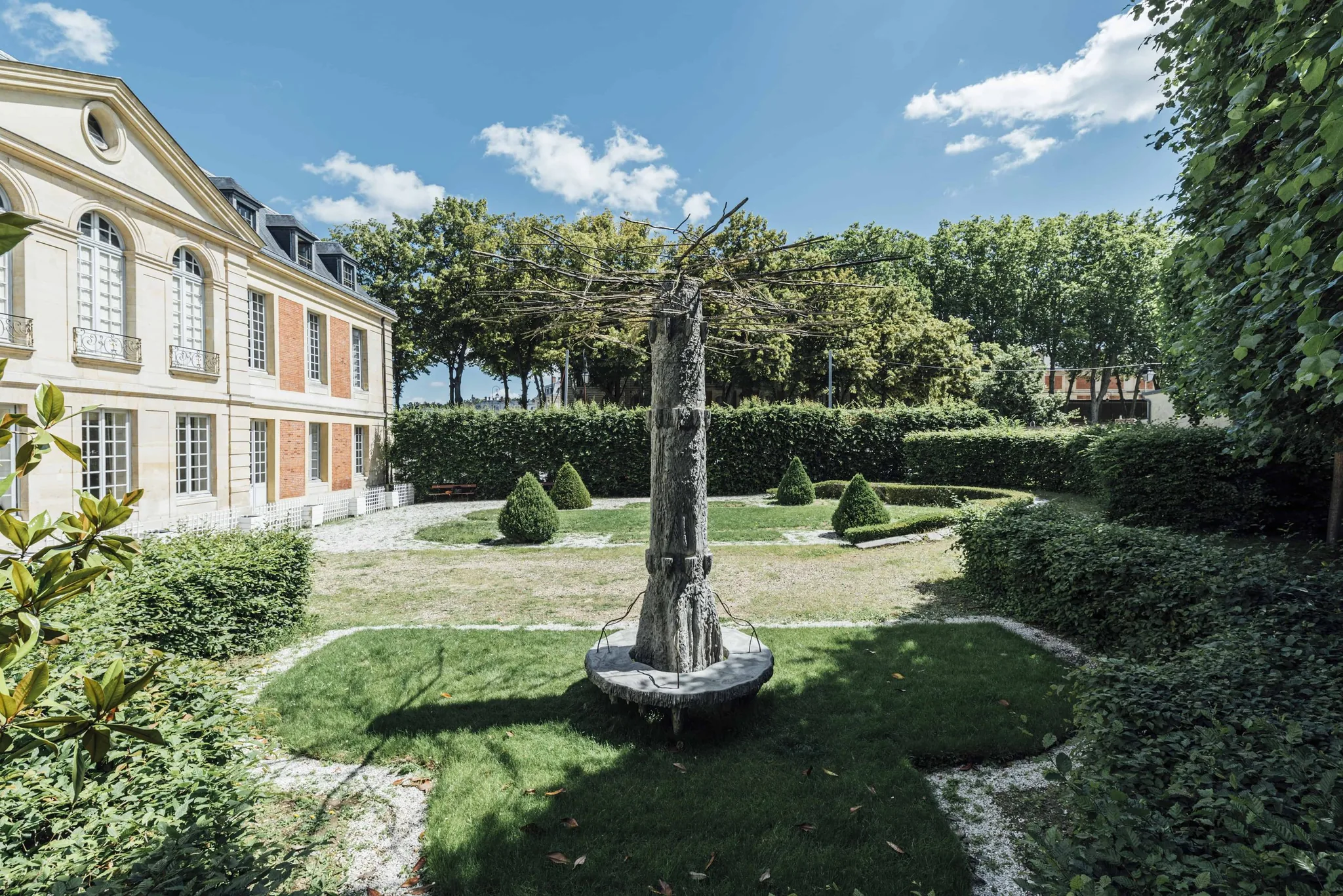
Structure for Eva Jospin, Versailles: 1 734 x 1 736 x 3 993 mm, 0.56 tons, produced with Freyssinet.
The appeal is not novelty. It is that printing removes the mould, and the mould is what has always limited sculptural concrete. A one-off double-curved form costs the same to print as a simple one, where formwork would make it prohibitive. Everything on this page follows from that single economic fact.
The second reason is that artistic work exposes the process. There is nowhere to hide a bad layer on a piece shown in a museum, which is why these projects have consistently pushed the print head and the material laboratory harder than commercial jobs.
Museums, galleries and commissioned works
The oldest piece in the collection is also the most institutional: a structural node exhibited at Centre Pompidou in 2017, designed by EZCT Architecture & Design Research and shown as a full-scale fragment of a spatial structure. Two years later the column for the Futurium Museum in Berlin was co-designed in a workshop with Berlin architects and printed in white cement, 500 kg for two metres of height.
The structure for Eva Jospin in Versailles is the largest: a four-metre tree form with an integrated seat, hand-ornamented by the artist after printing and installed in the garden of the Chancellery hotel. It is a useful example of printing as a substrate rather than a finish, with the machine producing the geometry and the artist producing the surface.
Heritage work follows a different logic. The votive niche at the Oise archaeological museum reconstructs the missing blocks of a first-century Gallo-Roman niche from the ancient city of Vendeuil-Caply, so that a fragmentary object can be shown whole. Here the printed part is deliberately subordinate to the original.
On the gallery side, the Cirratus vase by Patrik Schumacher and the ZHA Code team, shown at the Zaha Hadid Gallery in London in 2016, opened the long collaboration with Zaha Hadid Architects. More recently, an edition with Galerie ZEBRES and artist Edouard Boulmier produced console and side tables as functional sculptures, and a full collection was presented at the Maison & Objet fair in Paris in 2025.
Public art and the city
Municipal commissions are where artistic printing meets real use. In Bordeaux, brightly coloured skateable sculptures were developed with Agence Cote Ouest and skaters Leo Valls and Brice Fauquet: a bump, two transfers and a wallie that are sculpture and skate obstacle at once, and therefore have to survive being ridden.
Elsewhere the artistic intent sits inside street furniture. The moray eel bench in Saint-Cyprien runs ten metres along the beachfront, the urban totem in Rungis marks a business park entrance at 690 kg, and a bear sculpture was printed by EmPrinte for a childcare facility in Sucy-en-Brie. The Saint-Cyprien tourist office furniture, urban pots, green belts, flower boxes and Square, a modular cooling island all belong to the same family of work: designed objects that a city can order and maintain.
A wood and concrete sculpture for Takenaka Corporation in Japan, designed by Shimada Jun, interlaces a printed form with machined stacked frames in 29 minutes of printing.
Sculpture that goes underwater
The marine work sits between art and ecological engineering, and it is some of the most technically interesting. The artificial reef commissioned by Prince Albert II of Monaco began as hand sketches by record diver Pierre Frolla in tribute to oceanographer Albert Falco, and became a 3 x 3 x 3 m structure engineered with SETEC in vivo. The open dome developed with Seaboost pursues the opposite constraint: an ultra-light structure of openings that marine fauna can swim through, printed vertically at 90 degrees in 35 minutes.
Material research as artwork
Two projects are experiments that happen to be exhibitable. Leatherstone, developed in Tours for Mondes Nouveaux with Hors Studio and Bold Design, is a printed leather-based material free of petrochemicals with a low carbon footprint. The reaction-diffusion bench and the AI-generated printable porosity project, both from the Hi-DARS Lab at Texas Tech University, translate biological simulations and generated images into printable toolpaths.
Work of this kind rarely has a client waiting for delivery. It exists because a printing system that can only make catalogue parts stops improving.
What artistic work demands from a printing system
No second attempt. A commissioned piece has one deadline and one budget. The print has to succeed the first time, which is an argument for in-line quality control rather than post-hoc inspection, and one of the reasons 2K process control exists.
Geometry no one has printed before. Vertical printing at 90 degrees, non-planar toolpaths, 2.5D hybrid surfaces: these appear in artistic projects first because artists ask for them first. They then become standard options.
The surface is the work. Bead regularity and layer expression are not defects to hide but the visible texture of the object, which means they have to be controlled rather than merely tolerated.
Colour and unusual materials. Pigmented concrete, white cement, coated finishes and experimental compositions all run through the same print head. That is a materials laboratory question as much as a hardware one, and XtreeE runs both in-house.
XtreeE designs and manufactures the complete printing chain in France and sells it as an industrial system. The projects on this page were produced by XtreeE customers, partners and studios with that equipment.
Configure a printing system →︎
Browse all use cases →︎