Eighteen infrastructure projects, proven in the field
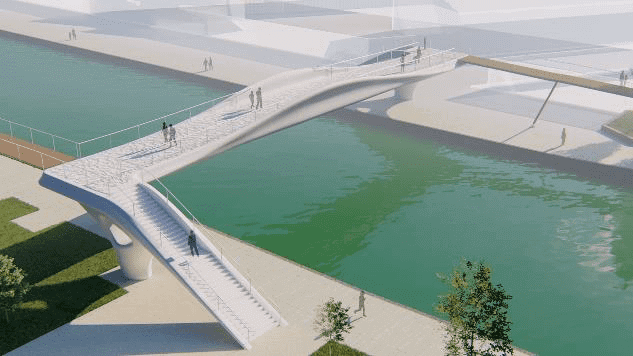
Aubervilliers footbridge: a 40 m deck made entirely of 3D printed structural concrete.
Infrastructure built with XtreeE technology spans bridges, telecom structures, tunnelling components, inspection chambers and marine habitats, delivered with contractors including Freyssinet, Spie Batignolles, SADE and GTM Normandie. Several of these structures have been in service for years, in the ground and underwater.
That track record matters more than any single project. Infrastructure clients do not buy a technology because it is new. They buy it because someone else already carried the risk, passed the inspections, and the structure is still standing.
Marine structures and artificial reefs
Seven of the eighteen projects are marine. It is the application where printed concrete has the clearest technical advantage, because the shapes that ecological engineering requires are the shapes formwork cannot produce: interconnected cavities, controlled surface roughness, graded pore sizes matched to the species being sheltered.
The X-Reef in the Calanques National Park, designed with Seaboost (Egis group), measures 110 x 90 x 110 cm for 900 kg per unit. XtreeE technology also produced five reefs in Monaco and an artificial reef commissioned for Prince Albert II, then the largest deployment to date: 32 biomimetic reefs at Cap d'Agde.
Marine work continues with walls for marine works, marine modules, and an ongoing research programme on printing directly underwater. Serial production is the operative point: 32 units means a system that repeats a geometry reliably, not a machine that produces one demonstrator.
Civil engineering and structural elements
The pedestrian footbridge in Aubervilliers is the reference project. Commissioned by Plaine Commune Grand Paris, it spans 40 metres with a deck made entirely of 3D printed structural concrete, a world first. It was delivered by a consortium led by Freyssinet (Vinci group) with Lavigne & Cheron Architectes, Quadric (Artelia group), XtreeE and LafargeHolcim. Structural printing at that scale is not a material question alone: it requires a process that engineers can calculate, inspect and sign off.
For the Aubervilliers Olympic Aquatic Center, twenty-nine bespoke columns were printed to carry the roof structure, hollow, up to 4.80 m tall, at roughly 78 minutes of printing per column. They were produced by emPrinte, the additive manufacturing workshop of Spie Batignolles, which illustrates the model XtreeE works to: the contractor owns the printer and runs the production.
Two further projects show the range. Beam nodes address the geometric complexity of structural connections. The tunnel boring machine starting bell in Rouen, produced with GTM Normandie Centre, lets the tunnelling chamber be pressurised to confinement pressure behind the diaphragm wall, replacing injected masses with a printed prefabricated part.
Underground networks and water management
Buried infrastructure is where bespoke geometry pays for itself immediately, because every existing network differs slightly from its drawings.
The inspection chambers in Roubaix make the case plainly. Three chambers had to be installed on an old underground brick gallery. The conventional method meant piercing the vault, with a risk of rupture propagating into general collapse. Printed manholes were instead shaped to match each existing geometry, fixed to the vault and providing local reinforcement. The project ran with Point P Travaux Publics, SADE and Artelia. The stormwater regulator in Lille follows the same logic: a part designed around a network, rather than a network adapted to a catalogue part.
Telecom and standalone structures
The telecommunication mast is the largest single element in this group: 12 metres tall, 6.3 tonnes, developed with Art & Fact Innovation for deployment in Guadeloupe, engineered with Lamoureux & Ricciotti Ingénierie, produced by Freyssinet with LafargeHolcim material. It has to withstand earthquakes and cyclones while integrating into the landscape, a combination of structural performance and visual quality that a standard steel pylon does not offer.
Alongside it sit public realm structures where infrastructure meets urban design: a biodiversity tree in Montpellier, skateable sculptures in Bordeaux, an open dome, and a stacked wall exploring the assembly of printed segments.
What infrastructure demands from a printing system
Across these eighteen projects, the same requirements recur, and they are what separates an industrial printer from a laboratory setup.
Process control, not just material. A structural element has to be reproducible. The XtreeE 2K approach injects admixture in line at the print head, so rheology is adjusted in real time rather than fixed hours earlier in a mixer. That is what makes the twenty-ninth column match the first.
Traceable production data. Public works require evidence. Every print produces a record: flow rates, speeds, layer times. XtreeE Control and Data Intelligence turn that into the documentation an engineering office asks for.
Production where it makes sense. Most of these elements were prefabricated in a workshop under controlled conditions, then transported and installed. That is deliberate. Precast plants and civil works contractors are the ones who own these systems and run them.
XtreeE designs and manufactures the complete printing chain in France and sells it as an industrial system. The projects on this page were produced by XtreeE customers and partners with that equipment.
Configure a system for infrastructure production →︎
Browse all use cases →︎