New to the technology? See our printers and print heads in detail →︎
A definition
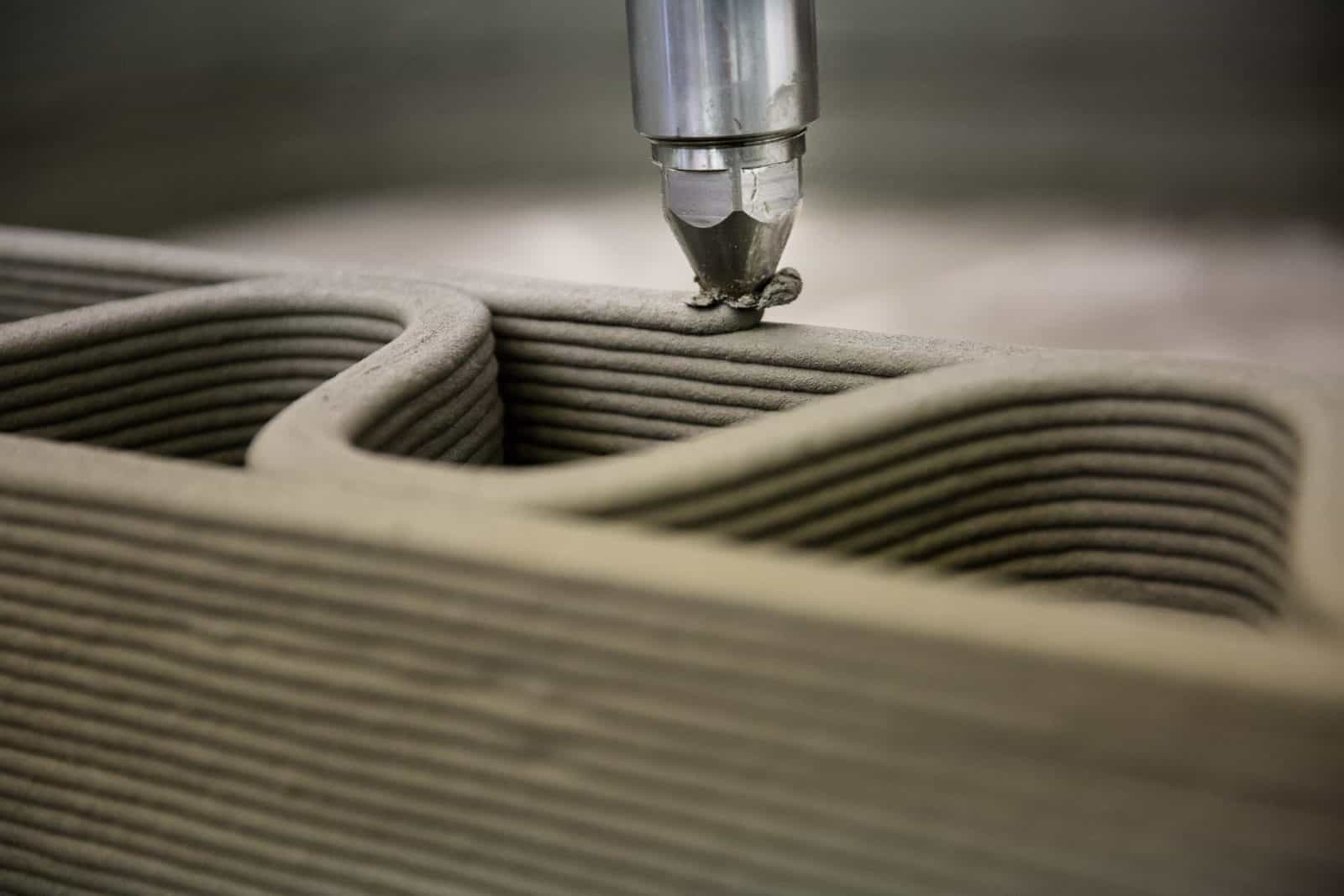
3D concrete printing, also called additive manufacturing for construction, is a process in which a robotic arm or gantry deposits a specially formulated mortar in successive layers to form a physical object. The shape is generated from a digital 3D model, sliced into printing paths, and produced without the moulds or formwork that traditional concrete construction requires. This removes a major cost and time constraint: complex geometries become no more expensive to produce than simple ones.
3D printed concrete stormwater regulator, Lille: a complex functional part made without formwork.
The technology has moved well beyond the laboratory. It is used today to produce design objects and furniture, larger prefabricated elements such as facade panels and bridge segments, and, increasingly, structural components for real construction projects.
How it works, step by step
A large-scale printing system brings together several coordinated subsystems. Dry material is mixed and pumped to a print head mounted on a robot. The robot follows the toolpath generated by slicing software, while sensors monitor flow, speed and geometry in real time. The result is a printed object built from the ground up, layer after layer.
The core challenge is timing. The material must be fluid enough to be pumped and extruded, yet firm enough to hold its shape and support the layers printed above it. How a system solves this challenge is what separates the two main families of concrete printing.
1K vs 2K printing: where the intelligence lives
The real question behind any 3D concrete printing system is not simply which machine to buy, but where the control over the material should live: inside the material itself, or in how the process is managed.
1K printing (one component) relies on a single pre-formulated mortar, pumped and printed as is. The intelligence is concentrated in the material: its chemistry alone must guarantee both pumpability and stability. This makes 1K simple to set up and well suited to prototyping, research and standard geometries. Its limits appear at scale: there is no real-time adjustment during printing, a heavy dependence on specific and often costly formulations, and heights and shapes constrained by the mix's open time.
2K printing (two components) combines a base material with a liquid accelerator, activated on demand at the nozzle just before extrusion. This distributes the intelligence between the material and the process, and unlocks real-time control over curing. The benefits are decisive for industrial work: reactive adjustment during the print, simpler and more affordable base materials, and geometric freedom without open-time constraints. This is the approach XtreeE has developed and refined for demanding structural and industrial applications.
The two are not mutually exclusive. An XtreeE 2K print head also runs in 1K mode, so the choice of where your intelligence lives can move with the needs of each project. Explore the 1K and 2K technology in 3D →︎
What can be 3D printed in concrete?
The range of applications is wider than most people expect, and XtreeE has delivered projects across each of them.
Architecture and housing. Printed walls and building elements make it possible to build certified homes faster and with more design freedom than conventional methods. Our Viliaprint project in Reims produced the first certified 3D printed houses in France.
Infrastructure. The technology handles complex, load-bearing forms that would be prohibitively expensive with formwork, from a tall telecommunication mast to a pedestrian footbridge.
Environment and ecological engineering. Printed geometries can be designed to host marine life, as with our X-Reef artificial reef immersed in the Calanques National Park.
Art, design and furniture. Artists and designers use concrete printing as a creative medium for sculptures, urban furniture and ornamental elements impossible to mould by hand.
Browse all 62 built projects →︎
Why it matters for construction
Beyond design freedom, large-scale 3D concrete printing addresses concrete challenges facing the construction industry: reducing material use by placing concrete only where it is structurally needed, cutting the waste and cost of single-use formwork, shortening production times, and enabling shapes that improve both performance and aesthetics. For an industry under pressure to build more efficiently and more sustainably, additive manufacturing is becoming a serious industrial tool rather than a novelty.